Based in Zürich
Creative mind and founder.
I build at the edge of perception and simulation.
Projects
ArtTech HackHackathon organiser · Association co‑founder 2026
In 2026 I co-founded the ArtTech Hack Association. Our goal is to bring creative and tech students in Zürich together and to build the missing bridge between them. Recently we organised a hackathon that drew 151 applications for 50 spots.
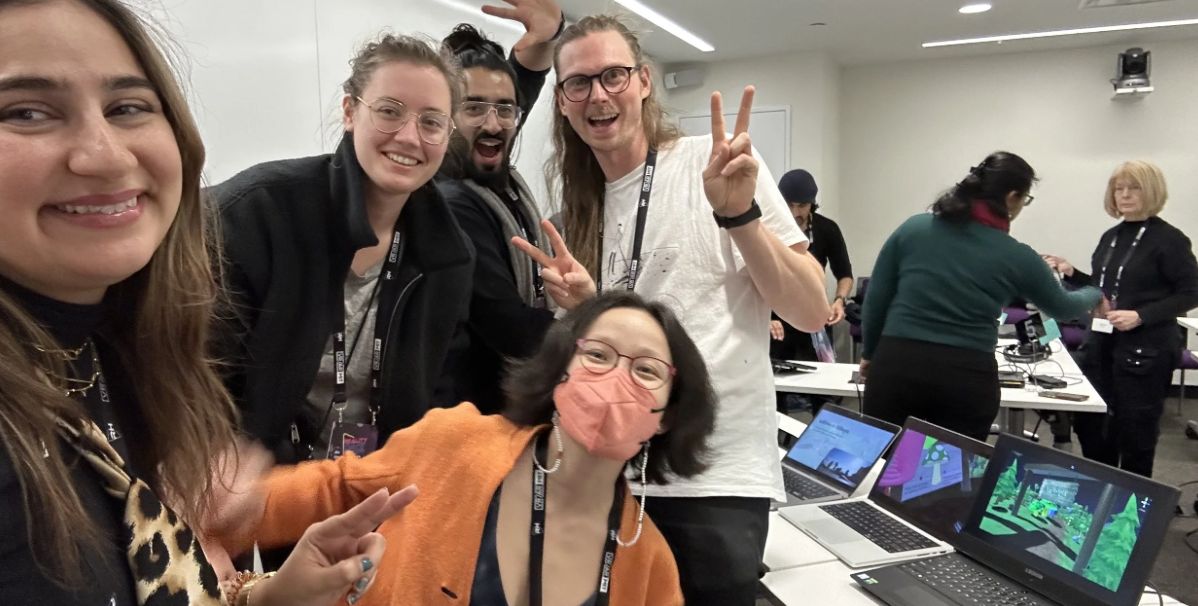
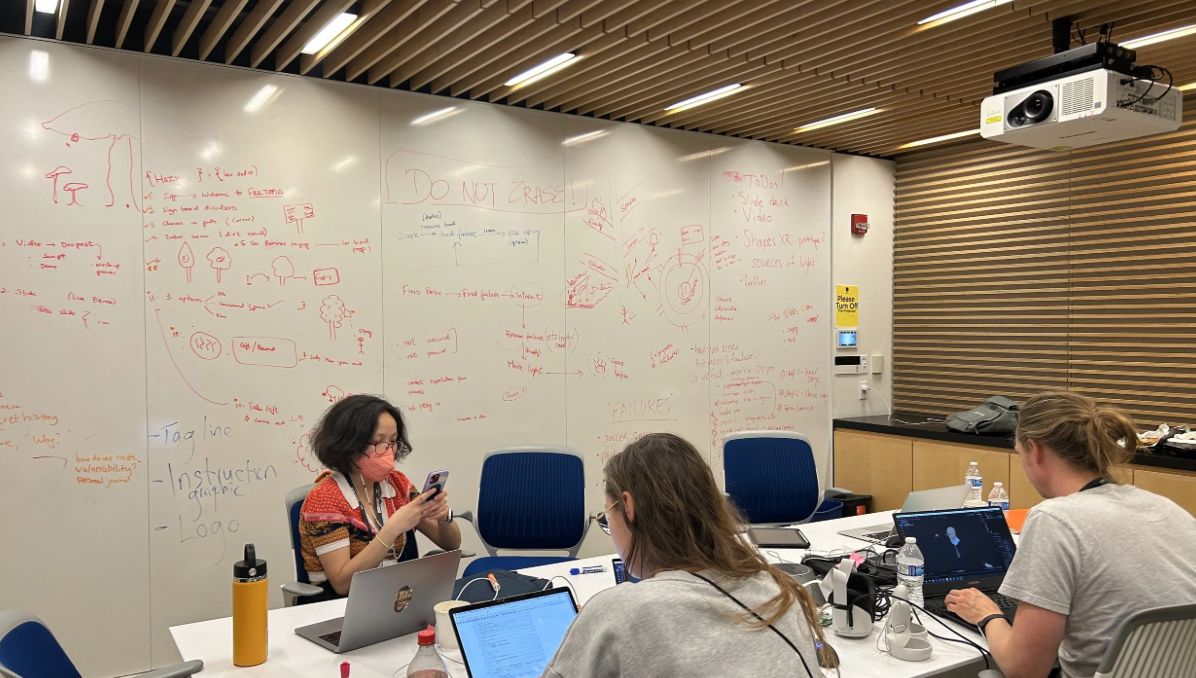
Failtopiaon failure 2023
An immersive multiplayer VR forest where university students listen to failure stories through mushrooms with tin-can telephones, record their own, and plant them to grow new ones. Failure is simply unmet expectations, and it has taught each of us so much.
Grand Prize · MIT Reality Hack 2023
Algaeiaon making the unheard audible 2022–25
An AR experience that immerses you in the underwater soundscape of Lake Zurich, making human noise pollution from ship engines audible. It began as web VR at a 2022 hackathon; an orange buoy on a bench at the Strandbad is now the portal.
1st prize · DODO Hackathon 2022 · Urban Waters exhibition 2025
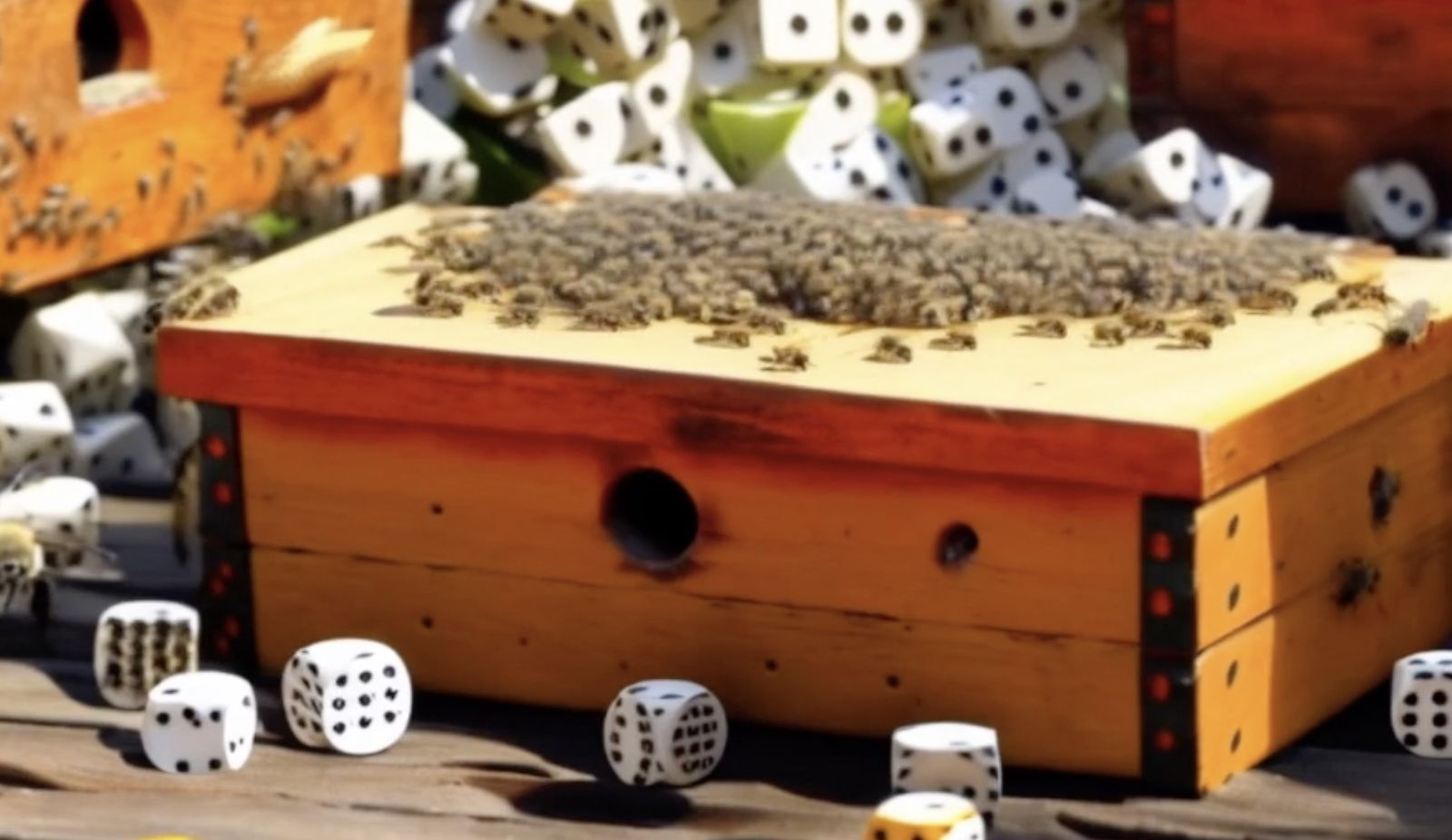
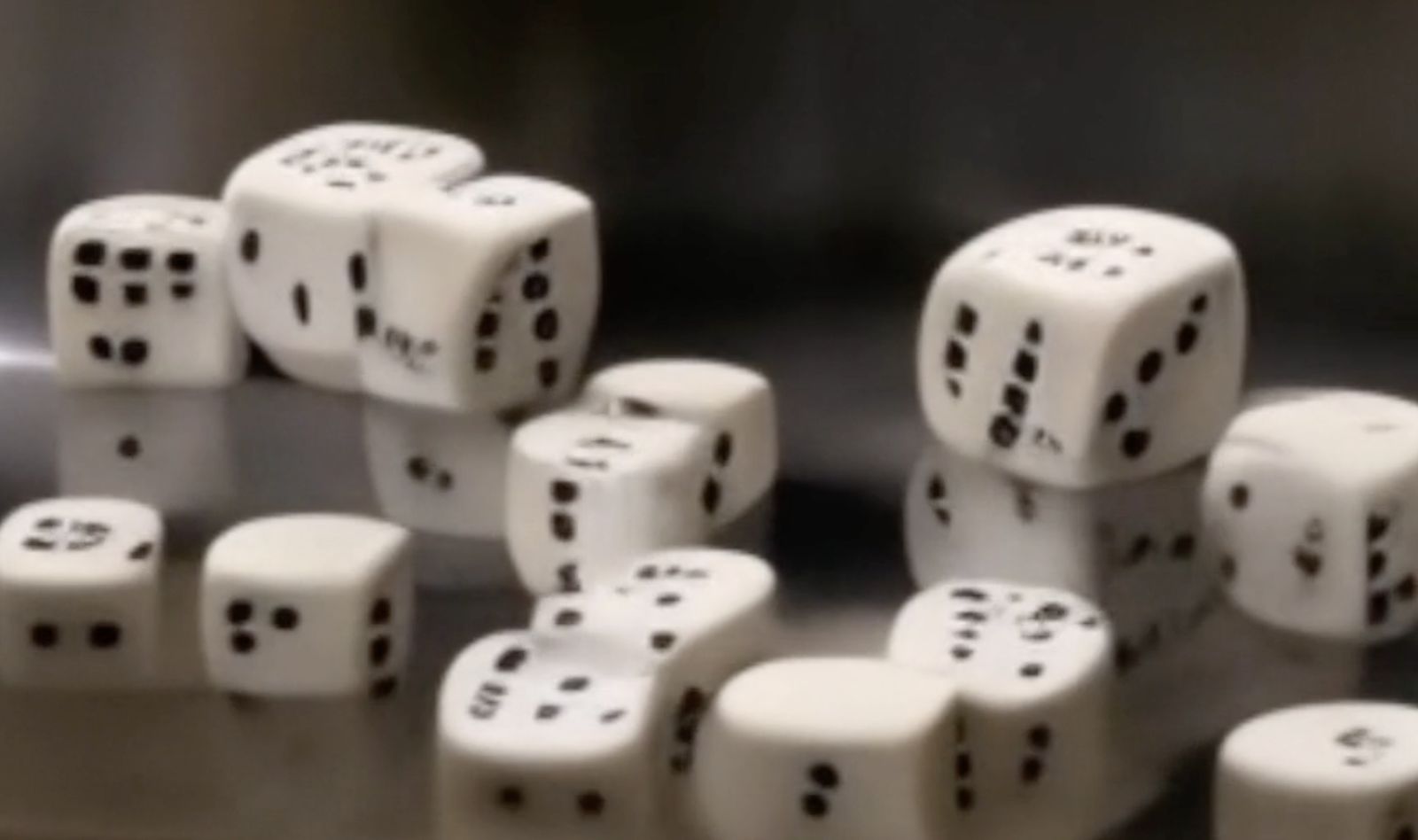
Distorted Diceon how machines see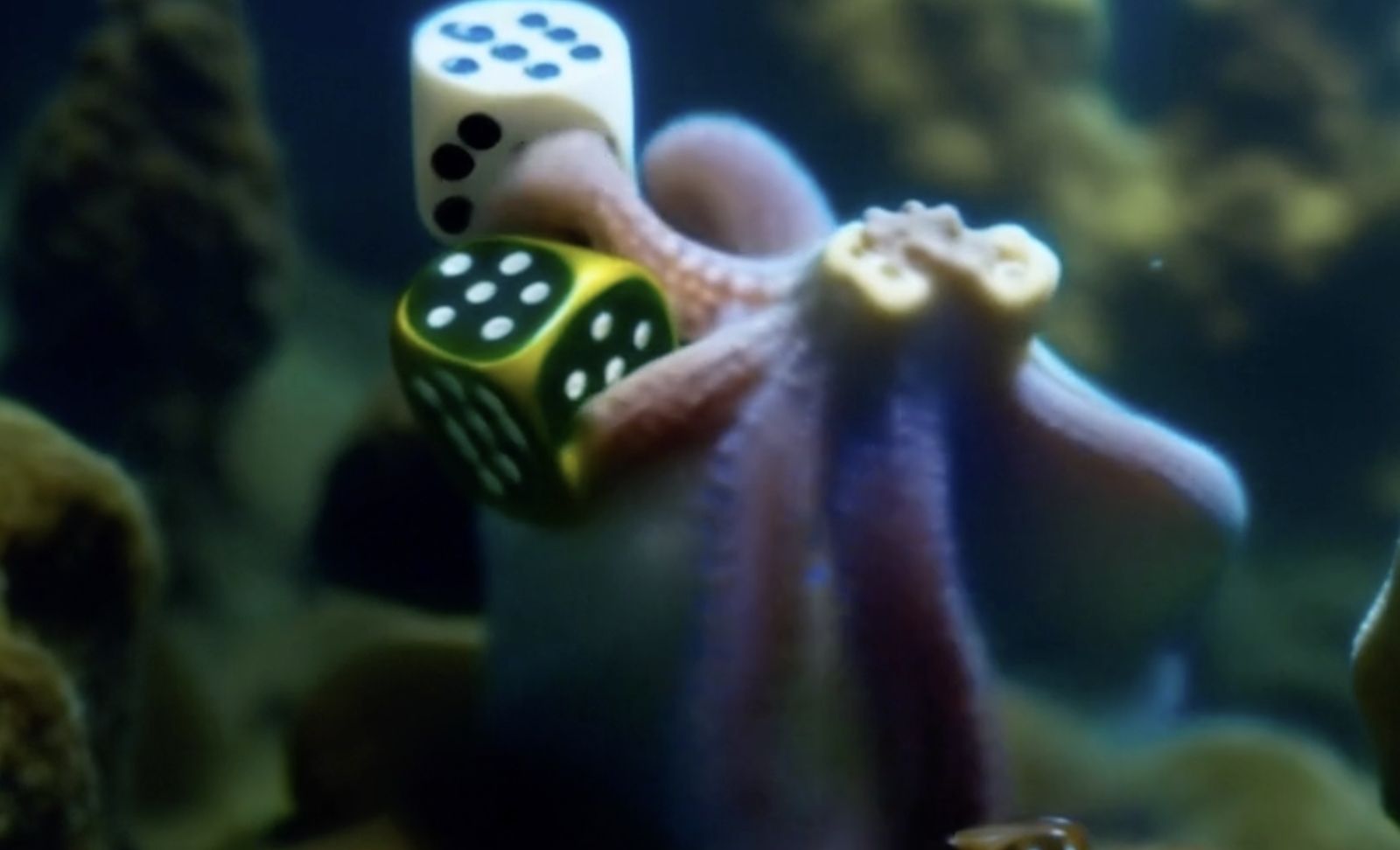 2023–
I ask video generators like Pika and Sora for dice. None of the dice has the correct number of dots: a quiet, unsettling reminder that even with immense computational power, AI still struggles with fundamental spatial reasoning.
eXistenZon the disappearing interface 2022
My final MFA work, tied to my thesis Entangled Viewer: what happens to the boundary between artwork and viewer when the interface disappears.
MFA with distinction · ZHdK
A digital herbariumon seeing in three dimensions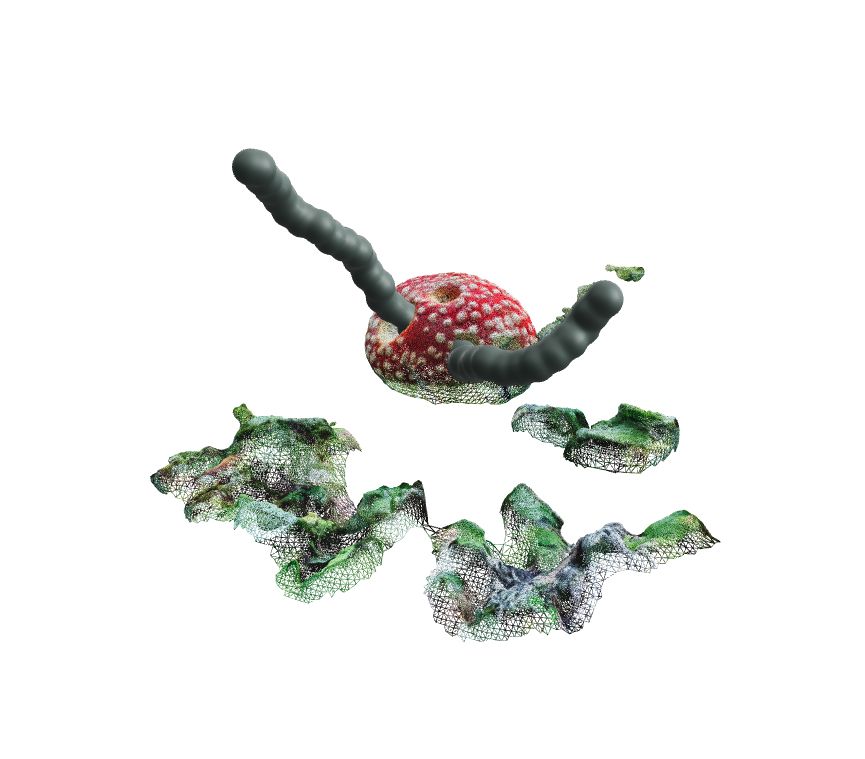 2020
During my residency I 3D-scanned the mushrooms and plants of Safiental: a preserved archive of the valley's flora and fungi in three dimensions.
Hackathons
Art school gave me the freedom to explore. Hackathons turned me into a builder.
- 2026IDEASHACK3rd
- 2026Agentic Hack Zürich DeepMind × Vercel × ASL3rd
- 2025XRCC Berlin Meta Education × Logitech track, best trailerWinner, 2 tracks
- 2025SwissHacksRaiffeisen case winner
- 2024Fondation Beyeler Art Lab HackathonBest in social impact
- 2023START HACK Finalist, top 5 of 100+ teamsSIX case winner
- 2023MIT Reality Hack team FailtopiaGrand Prize
- 2022DODO Hackathon team Algaeia1st
- 2022Hackathon the Spirit Immersive Tech Week Rotterdam · team Octopi1st
- 2022Hacking for Humanity Girls in Tech · Esri challenge · team Wild Herbs1st
- 2022A MAZE Museum Online Hackathon “AR you ready?” · AR audio walk Melli Beese2nd
In 2026 I switched sides and co-organised ArtTech Hack →
Teaching
Demystifying AI and hackathons for artists and designers.
- 2026From Hackathon Participant to Organizer Guest talk · seminar “Take off: Mein Projekt vermitteln”, Zurich University of the Arts (ZHdK)
- 2025Generative AI Demystified Winter School, ZHdK · 2.5-day hands-on workshop · 16 participants
- 2025My journey into hackathons and why they have become an essential part of my life Guest talk · seminar “Take off: Mein Projekt vermitteln”, ZHdK
- 2024Generative AI Demystified Winter School, ZHdK · 2.5-day hands-on workshop · 15 participants
- 2023Curriculum development and assessment in the age of AI Creative Economies Forum, ZHdK
- 2023Mentor HackUPC, Barcelona
- 20203D scanning workshop Biennale Art Safiental
Writing
Essays on focus, endurance and seeing.
Hover over a book to read the opening; click to read the whole essay.Tap a book to read. Swipe for more.
The manifesto · 2026
Those Green Squares on GitHub: On Running and Treating Life as a Hackathon
Running is repetitive by design. You choose a route, adjust your pace, and return to it again. What changes is not the path but your calibration. Progress rarely comes from one exceptional effort. It accumulates through small corrections applied consistently.
Improvement is not a decision made once. It is an ongoing negotiation. You respond to fatigue, terrain, weather, yesterday's load. Some days require intensity. Others require restraint. What matters is not forcing output but staying responsive while continuing forward.
The word hackathon combines two ideas that are rarely held together: hacking and marathon. Hacking questions systems. It searches for alternative approaches, reframes constraints, and tests assumptions. Marathon implies endurance. It is not speed alone, but sustained effort under limits.
A hackathon only works because both elements are present. Without hacking, it becomes blind endurance. Without marathon, it becomes scattered experimentation. The pressure of limited time exposes weak assumptions quickly. Ideas collide with reality early. You either cling to your initial concept or you iterate. Progress belongs to the teams that adjust fast without losing direction.
Treating life as a hackathon does not mean living in a permanent sprint. It means combining endurance with iteration. Commit to a trajectory, but continuously refine how you move toward it. Intensity without feedback leads to collapse. Feedback without consistency leads to noise.
Running made that logic tangible. The temptation to override signals and push harder feels productive. It is not. Ignoring feedback only delays consequences. Calibration requires more discipline than stubbornness. Knowing when not to push is part of sustained progress.
This is why I began logging my runs on GitHub.

The Contribution Graph visualizes a year of activity as a grid of green squares. Each square represents a day. Each shade reflects volume. Empty days remain visible. In software, commits are not claims of perfection. They create traceability. They show how something evolved.
Using that structure for running turns consistency into something operational. Most runs are ordinary. That is the point. Each entry marks continuation. Over time, patterns emerge in effort and recovery. The graph does not optimize the run itself. It documents continuity.
The paradox is deliberate. The tracking system exists outside the practice so the practice can remain simple. While running there is no dashboard, no metric chasing. There is breath, rhythm, terrain. The structure supports the work without interfering with it.
In this sense, hacking is not about breaking rules. It is about repurposing systems. A developer tool becomes a training log. A contribution graph becomes a commitment device. The combination of hacking and marathon becomes a way of operating: question, endure, adjust, repeat.
Without endurance, iteration has no weight. Without iteration, endurance becomes rigidity. The work is to hold both and build systems that make that balance sustainable.
See the log on GitHub: daysofrunning.log ↗
Essay · 2026
Skiing in fog
Last Saturday, after a lunch break, I stepped back onto the slope and the fog had arrived.
Skiing in fog is a quiet lesson in focus. The horizon disappears. Depth flattens. What usually guides you — shadows, contours, contrast — dissolves into white. You cannot plan three turns ahead because you cannot see them.
So you commit to the one you are in.
You feel the pressure under your feet, the edge biting into snow, the subtle shift of weight from one side to the other. The body continues a pattern it learned long before this moment of uncertainty. Not because it sees clearly, but because it practiced when clarity was available.
Fog reduces the future to a few meters.
And maybe that is why it sharpens attention. You stop negotiating with what might come next. You focus on balance now, on the present arc of movement. The next turn will reveal itself only once you finish this one.
Skiing in fog does not teach you how to see better.
It teaches you how to move forward when you cannot.
Essay · 2026
On Paragliding
Thoughts that frequently cross our minds are meant to be addressed, like open browser tabs waiting to be resolved or closed.
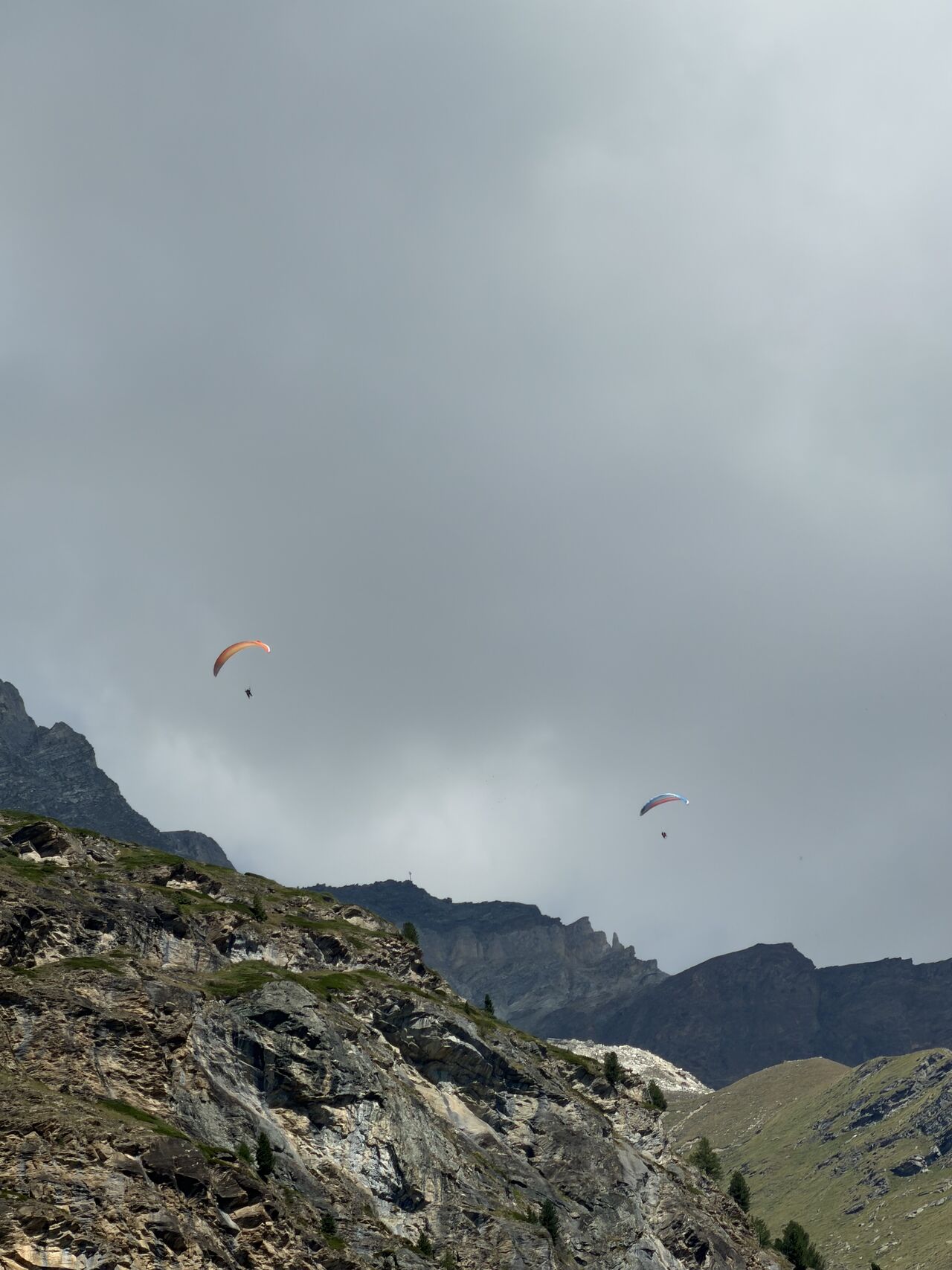
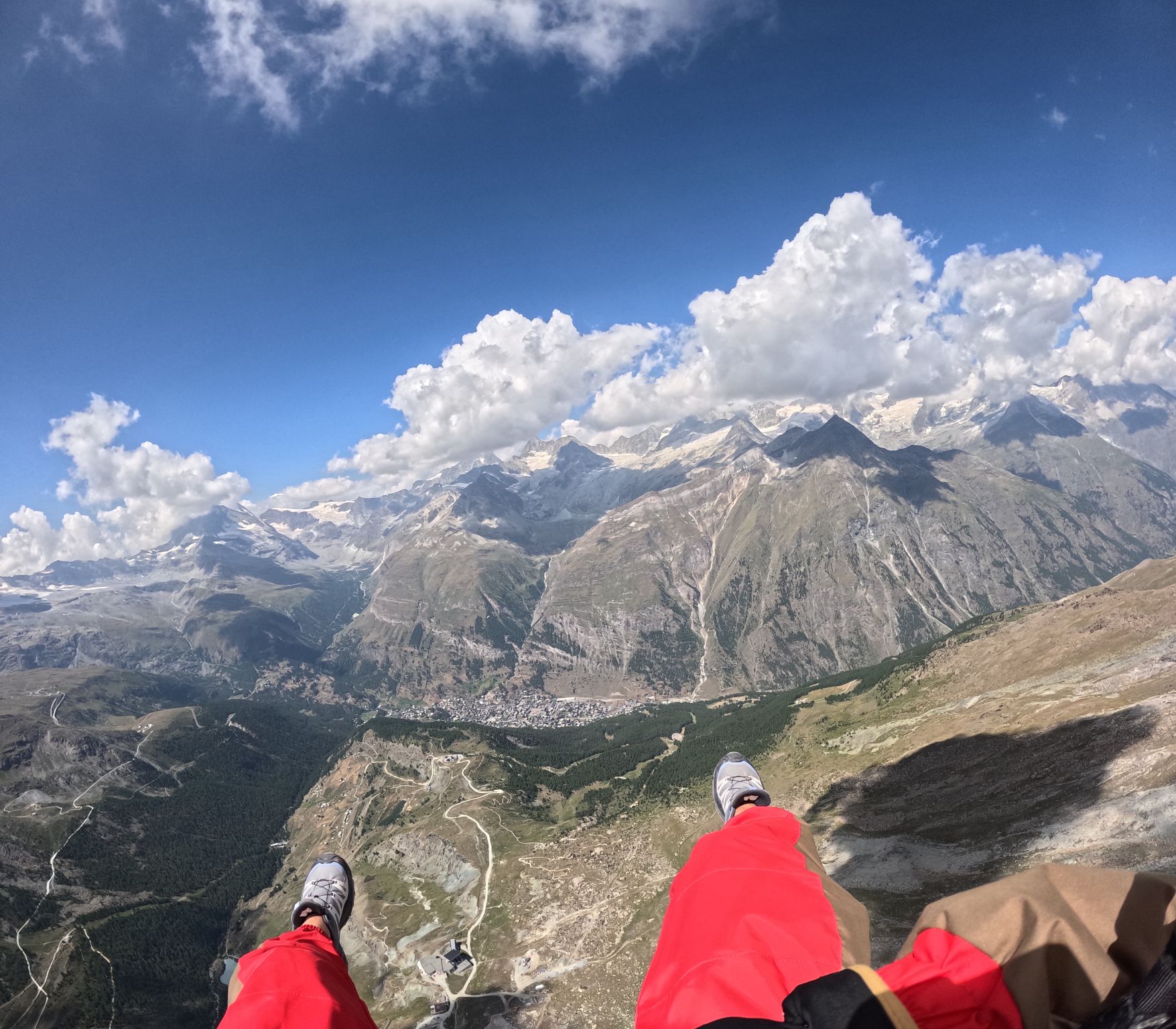
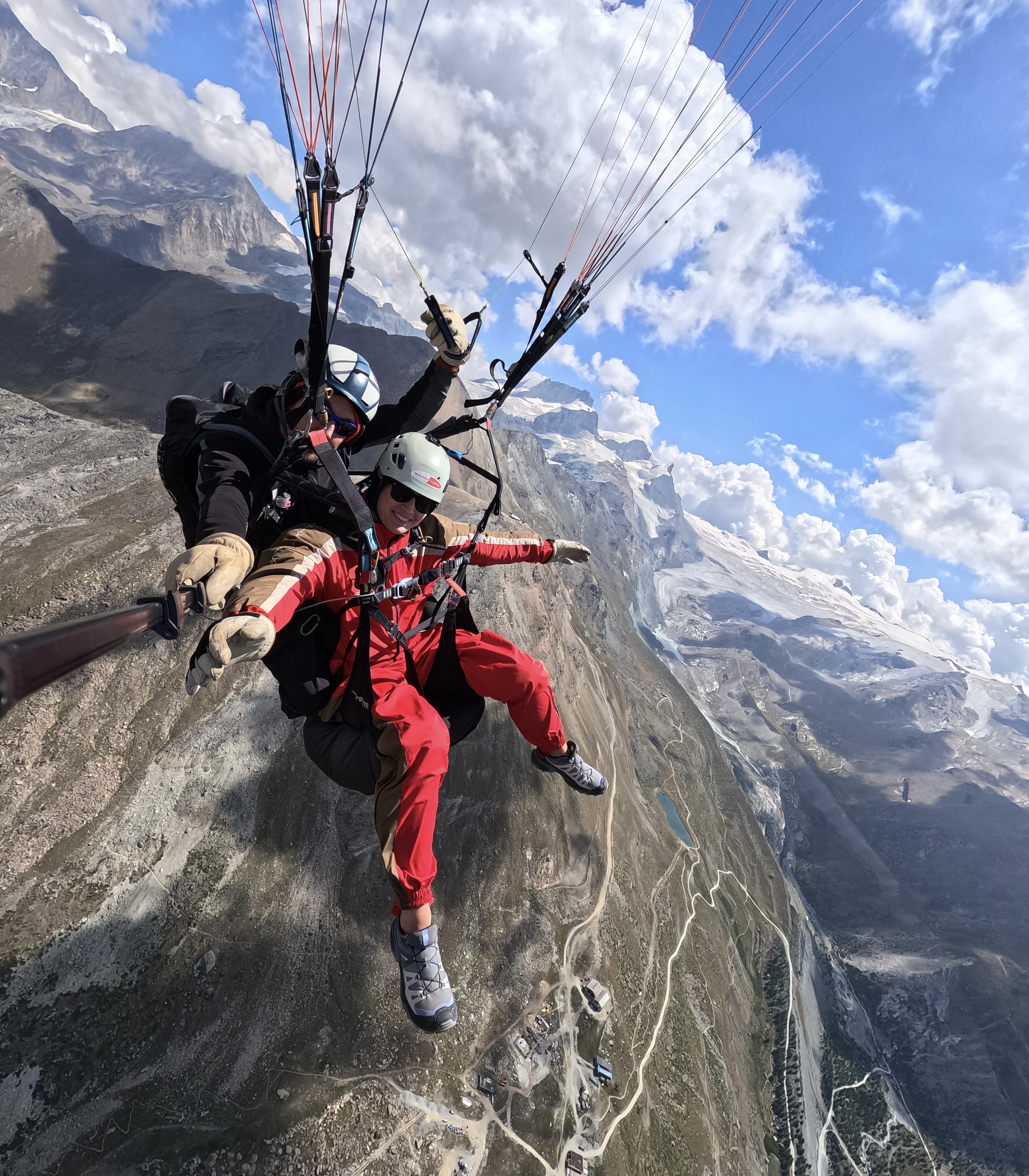
Paragliding was an open tab in the back of my mind for a long time. I often watched paragliders from below, fascinated by how a wing can carry a human through the air.
When I finally decided to address this open tab, I expected to step outside my comfort zone. Instead, as the cable car reached the Rothorn at 3,103 meters, a total inner calm settled in.
Like anything of significance, execution requires commitment. You have to decide. You have to move. You have to in this case run off the edge.
While in the cable car, one of the instructors pointed out a marmot on the rocks and spoke about small risks and reincarnation. I told him I'd prefer being reborn as a jellyfish: floating and moving with the current.
I guess that's the closest description of the feeling of paragliding: a pure flow state. Present, weightless, reacting to the dynamics of the air.
What open tabs are waiting in your mind, and when are you addressing them?
Essay · 2026
On open water swimming
Besides cold plunges in Lake Zurich during the colder months, I swim indoors during winter.
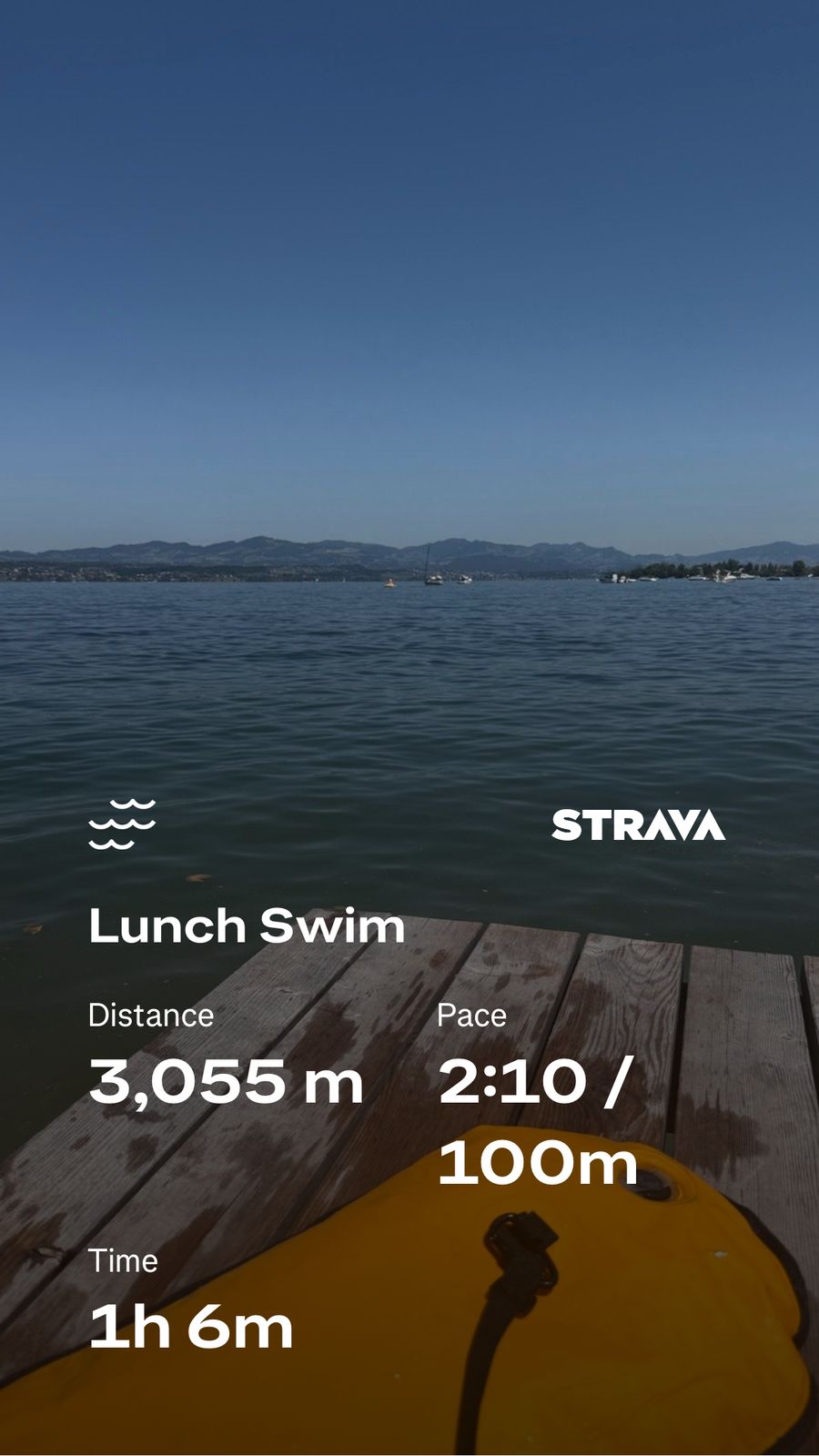
May is the month when I usually trade the pool for open water until autumn. Having grown up at the lake, swimming is a life-long part of me.
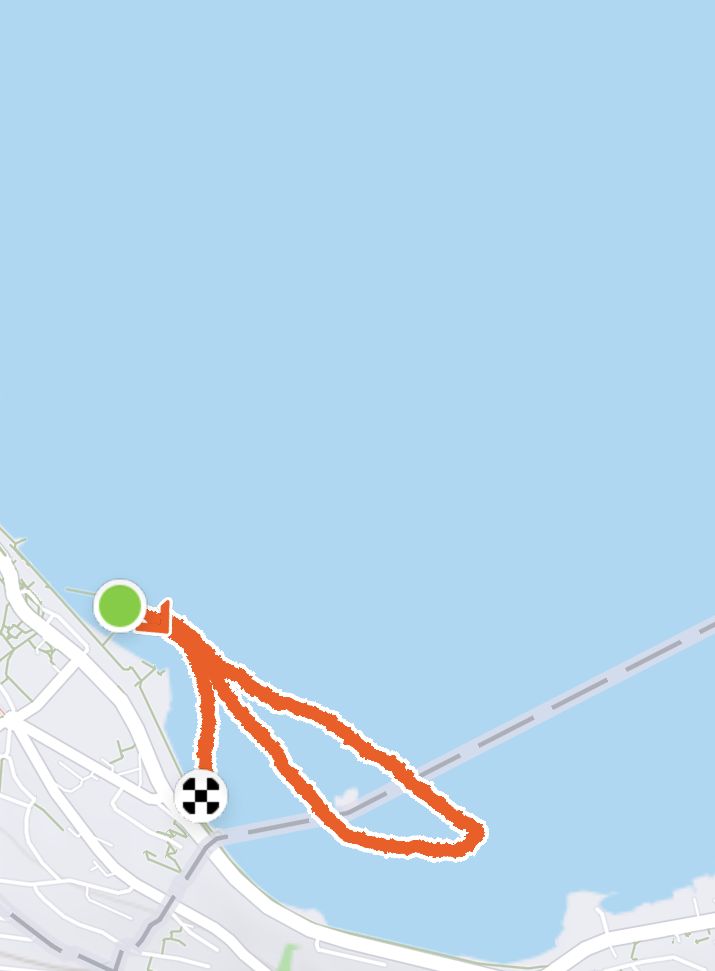
Over the years I got into open water swimming. Compared to the pool, the lake has no predefined tracks to guide you. You choose how to navigate. It is a continuous loop of movement and correction. Submerge. Stroke. Look up. Repeat.
In open water, focus narrows to the immediate feedback of the body. The catch of the water. The breathing technique. The drop in temperature as you move through different currents depending on where you are in the lake.
If your mind wanders, the lack of attention has an impact. A sloppy movement breaks the rhythm.
You cannot overthink the distance ahead. You have to rely on your endurance.
Open water swimming demands absolute presence. If you lose focus, you drift off course.
You carry that clarity back to dry land. In the water, as in building anything else, focus is not a passive state. It is a continuous, active correction.
Essay · 2026
On Cycling and Routes
You clip in.
A small sound. A click. And then you're cycling.
Before that moment, the route ahead is still abstract. Distance is a number. Direction is a choice. Everything remains reversible.
Cycling accumulates quietly. The kilometers behind you become more.
Along the way you sometimes forget that you can stop. You keep the rhythm. You tell yourself you'll pause at the top of the hill when the view opens up. You are chasing a finish line.
What if at some point along the way you decide unclip?
Not at the endpoint. Just at a point. The lake below, the light dancing on the water, the mountains resting where they always are. Nothing planned. You just let it happen.
The pause doesn't cost anything. The route is still there.
To stop is not to interrupt. It is its own movement part of the journey. It is the choice to be where you are instead of where you are going.
You clip back in.
The ride continues, but the momentum has changed. The clip-out is as deliberate as the clip-in. It is the moment the route stops being a task and starts being a place.


Essay · 2023
On balance: On presence and Absence
How I learned to „take my time" again after losing a parent early on.
There is a common saying that one should „take one's time". Everything that you want to become good at takes a lot of time and dedication. I am walking around with a camera for most of my life so far. As a kid I was always deeply fascinated, when I joined my mom on a frequent basis to pick up the developed photographs at the local photography store that doesn't exist anymore.
To me even though a photograph is 2 dimensional, it was like the perfect imitation of reality. Looking at a developed photograph seemed like a moment in time was magically frozen within a photograph.
When I was around fourteen years old I started to take learning photography seriously. After learning the basic mechanics of a camera, it took a lot of practice and time to learn how to use light in a good way and to figure out what I want to focus on and what I wanted to have in the frame.
By the time I entered art school when I was around eighteen years old my photography professor told me that I don't really need this course. Which was in my opinion not completely true, since I learned how to handle the gradient curve in photoshop and therefore minimized the adjustments/postproduction on photographs. Before art school my photoshop workflow was an unnecessary complicated mess.
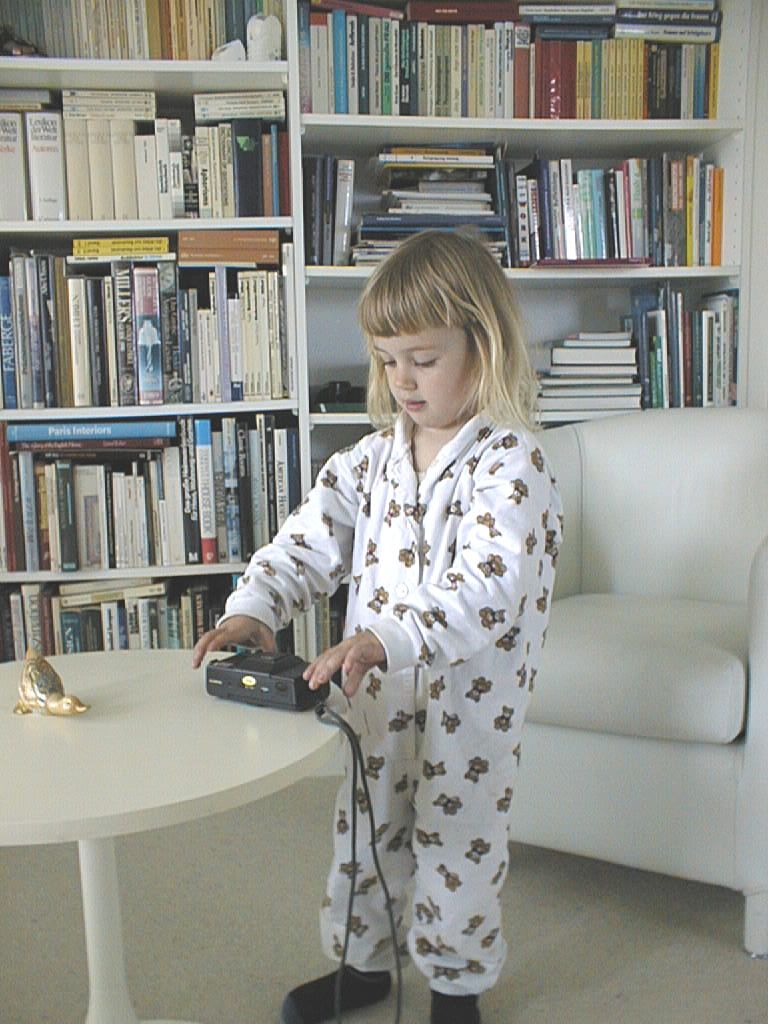
Even tough I extended my skills towards photogrammetry and LIDAR scanning, because I became more and more interested in the illusion of depth on screen and switched from a professional camera back to iphone photography in the meantime, my interest for „learning how to see" the world through different lenses is something I will never get bored with. In the end it's never really about the camera you have. The camera is just a tool that helps you to see in a different way: A tool that makes you reflect about what is in the focus, in the spotlight and what is left out of the frame. What remains blurry out of focus.
The process of learning how to photograph, how to see, is something that you can not really show, it is work happening out of the spotlight. At some point people started to tell me things like „You are very talented". Whereas I agree that for example certain traits like being hypersensitive help me to naturally notice a lot by default, a lot of what gets labeled as „talent" is simply a lot of practice, time and energy investment.
My fascination for „vision", more precisely „perception" led me later on towards a fascination for Computer Vision and since an early age I am fascinated by constructed worlds on screen whether it is in Computer Generated movies or Games. To this day I am a fan of certain Pixar movies like Toy story or the short animation story Geri's Game. Extending my skills in those fields took a lot of additional practice. Learning a lot about linear algebra, matrices and questioning whether I can really learn this (And the answer is yes, never give up when you don't get a concept the first time you read about it).
This brings me back to the topic of taking ones time. Since November 2018 I was sort of in a rush. I felt like I was running out of time. I was 21 and a half at that time. Those who know me in person know what happened in November 2018, those who don't can read about it now.
There are moments in everyones life that divide ones life in a before and after. They turn ones inner world upside down and put one on a roller coaster that doesn't seem to slow down. These moments are the most challenging one will ever encounter, making one aware with all their intensity that the only resource everyone of us on earth has the same amount of 24hours per day is limited. It's not that I haven't experienced grief before, yet in November 2018 I was faced with the most intense grief possible: The grief caused by the sudden loss of a parent.
When I was faced with that reality I had to accept it. I had to say yes to my new life, since I didn't have a choice. The absence of a choice is hard to handle, yet I decided to accept the challenge.
My father was always incredibly aware of the fact that time is a limited resource. He often said „Doing this would be a waste of ones lifetime" or „one only has a limited amount of kilometers in ones life". He once told me that he only replied to emails at work when the sender stated clearly in the header what the emails purpose is about.
When people learn about the fact that my father is no longer alive: I often hear people saying things like: „but dying in your mid sixties is quite early." As if how long you live tells anything about the quality of your life.
As a little anecdote: When I was fourteen years old, stuck in Gymnasium I once went to the career counseling, because all I wanted is to go to art school and I was looking for possible paths. And this career advice guy whom I really couldn't stand. He asked me to take an online test to figure out what job would be fitting for me: I told him I want to go to art school, he insisted on me taking the test and surprise surprise the result was artist or computer scientist. A third result was Baker (I mean there was a question in the survey whether I enjoy baking cakes or not, I mean who doesn't…). Well at some point during the conversation he was like „you have all the time in the world" (additionally he clearly had zero sense for art) and said nowadays humans die on average at the age of 85. What is the point of turning 85, if most of your lifetime is wasted?
The day my father died I became painfully aware of the fact that my time is limited, too. I started to live a bit in a rush since then. And only recently I came back to a state of relaxation, relearning to enjoy the here and now again and to go with the flow at my speed.
Ever since I was a kid I joined my dad for sessions at the Driving Range once in a while. Even though Golf never became a sport, which I was actively pursuing I remember something important that he once said, when I was in a rush to use up the golf balls as fast as possible: „Take your time, focus and slow down." I decided to apply what he said to every aspect in my life.
In January 2023 I have flown to the States to participate in the MIT Reality Hack, which was held under the motto of „presence". And I have to say I learned to be present again in the recent times. I learned to be balanced again: My flight from Boston back to Zurich was not booked out and the pilot announced at the beginning that everyone should please sit down on the place indicated on ones ticket to keep the weight distribution balanced as calculated in advance. And balance is what I comes down to in the end.
Over the course of 2022 I learned to take my time with certain complex topics in Computer Science and implement resting sessions, such as going for walks, bouldering and Swimming to implement a healthy balance. Swimming has always been a passion of mine. I like the moment when you dive below the surface, or being in this flow state surrounded by water in genreal. Being surrounded by water has healing energy. I found a strategy over the years to handle the day of the year that he died, I try to be at the sea and stare at the water, while walking along a coastline. The sea has a way of letting you know that the earth keeps spinning and that you are just a small puzzle piece in the universe and like waves show after downs there are ups again.
Publication · 2022
An Architectural History of Collective Virtual Spaces in Games
Essay for the publication meta.space, exploring the architectural history of virtual game spaces.
View publicationAbout
I've carried a camera since I was a kid. It made me curious about how we see, and later about how machines see.
Born in Zürich. MFA with distinction from Zurich University of the Arts (ZHdK), 2022. I came to code through art and to building through hackathons. I taught Generative AI Demystified at the ZHdK Winter School twice.
In 2026 I co-founded the ArtTech Hack Association. Our goal is to bring creative and tech students in Zürich together and to build the missing bridge between them. Recently we organised a hackathon that drew 151 applications for 50 spots. Right now I'm building my first startup. More on that soon.
Away from the screen: trail running, hiking, strolling through museums and training for Ironman 2027.
Always open to collaborations
info@sararutz.chFull CV
Sara Rutz, born in Zurich, CH
Education
- 2020–2022Master of Fine Arts (graduated with distinction) at Zurich University of the Arts (ZHdK), CH
- 2017–2020Bachelor of Fine Arts at Zurich University of the Arts (ZHdK), CH
Hackathons / Game Jams
- 2026Third place IDEASHACK
- 2026Third place Agentic Hack Zurich (Deepmind x Vercel x ASL)
- 2025Winner of the Meta Education with Logitech track and best trailer track XRCC 2025 Berlin
- 2025Winner of the Raiffeisen case of SwissHacks 2025
- 2024Fondation Beyeler Art Lab Hackathon, best in social impact
- 2023Winner of the SIX case and finalist of START HACK 2023 (top 5 out of 100+ teams)
- 2023MIT Reality Hack Grand prize team Failtopia
- 2022DODO Hackathon first prize team Algaeia
- 2022Hackathon the Spirit (Immersive Tech week Rotterdam 2022) first prize team Octopi
- 2022Hacking for Humanity first prize Esri challenge team Wild Herbs
- 2022A MAZE Museum Online Hackathon "AR you ready?" | AR-Audio Walk Melli Beese | second
Group Exhibitions
- 2025Urban Waters, Strandbad Tiefenbrunnen, Zurich, CH
- 2023The Seashore of Endless Worlds, Le Commun, Geneva, CH
- 2022Desired Lines – Degree Show Master Fine Arts, Zurich, CH
- 2021Diplom Redux Bachelor degree show, Kunsthaus Glarus, CH (cancelled due to Corona)
- 2020Analog - Digital, Biennale Art Safiental, Graubünden, CH
- 2020Tokyo - ZINE - Zürich, MATERIAL, Zurich, CH
- 2019ZINE IN TOKYO, POST bookstore, Tokyo, Japan
Residencies and Summer Schools
- 2025BODIES-MACHINES-PUBLICS residency at Immersive Arts Space ZHdK and Kornhausforum Bern, Switzerland
- 2023Places Hackathon in Residence, Gelsenkirchen, Germany
- 2022Student at "Ars Electronica Festival University" in Linz
- 2022Remote guide to Extractivism, summer school, shared campus, Athens and Elefsina, Greece
- 2020Residency at the Biennale Art Safiental, 2020, Graubünden, CH
Volunteer
- 2023Mentor at HackUPC, Barcelona, Spain
Teaching Experience
- 2025Generative AI demystified, Winter school 2025 ZHdK, February 2025
- 2024Generative AI demystified, Winter school 2024 ZHdK, 09. - 11. February 2024
- 2023Curriculum development and assessment - against the background of the rapid development of AI, ZHdK, Zurich
- 20203D scanning, Biennale Art Safiental, Graubünden, CH
Talks
- 2026Guest input called From Hackathon Participant to Organizer: Building meaningful communities and impactful projects through Hackathons in the Seminar Take off: Mein Projekt vermitteln, ZHdK, Zurich, CH
- 2025Guest input called My journey into Hackathons and why they have become an essential part of my life in the Seminar Take off: Mein Projekt vermitteln, ZHdK, Zurich, CH